From Deposit to Delivery: How Brewery Equipment Orders Run
Once the deposit clears, a brewery equipment order stops being a quotation and becomes a sequence of dated stages. The published schedule from deposit to door delivery is 90–150 days depending on the order, and that window is spent on design sign-off, materials, fabrication, jacket pressure testing, packing and freight rather than on waiting in a queue. Knowing the order of those stages is what turns a vague delivery promise into a date you can build a brewhouse opening around.

Key takeaways
- The published window is 90–150 days from deposit to door delivery, and it varies with the order.
- The design drawing is signed off before materials are cut, so late changes cost schedule time.
- Jacket pressure testing happens before insulation and cladding, while the steel is still visible.
- Five published inspection stages produce a record that travels with the shipment; the tank data plate carries the traceable serial number.
The clock starts at the deposit
A brewery equipment order begins with a specification, but the schedule begins with the deposit. Until the payment is in and the drawing is approved, the factory has no released work order, no reserved material and no place in the production plan. This is why a delivery date quoted before the deposit is best read as a capacity statement, and the same date quoted after the deposit is a commitment that runs the published 90–150 days.
Hermann asks for the working information up front: the batch size you intend to brew, the site and its ceiling height, the incoming power or fuel, the beers you plan to make and the budget you have set, which the company background describes as a business plan from scratch. A customised design proposal then fixes the vessel list for the hem brew system you are buying, and the project has a spine for the rest of the order.
Stage one: design and materials
The first stage is design freeze. Vessel sizes, the number of vessels, the heating method, valve and pipe routing, and the control level are settled in a drawing set. Once the drawing is released, stainless plate is ordered to the actual cut list, and the mill certificates are matched to the order — the first of the five published inspection stages, and the least expensive one to get right.
Changes made after this point do not merely cost money; they push every later stage back. A vessel that is one size larger after cutting has to be rebuilt, and the whole downstream calendar, including the slot in the packing hall, shifts with it.
Stage two: fabrication, testing and packing
Fabrication turns plate into vessels: shells rolled, cones formed, jackets fitted and welded, and the frame and platform built around the layout agreed in the drawing. Dimensions and welds are inspected while the tanks are still open, which is the second published inspection stage and the one that catches most fit-up problems.
The jacket pressure test comes next, before insulation and cladding close the cooling channel out of sight. Then packing: equipment is boxed in wooden crates, and the loading check compares the boxes against the order — the fourth and fifth of the published stages, ending with a leak test on the finished vessel and a data plate that carries its serial number and pressure-test record.
Stage three: freight, arrival and commissioning
Sea freight is usually the longest single segment that the factory does not control. Port congestion, vessel schedules and inland haulage are the reasons the published range is a range rather than a fixed number of days. The 90-day end of the band belongs to short, standard, well-specified orders; the 150-day end belongs to large custom plants with more vessel work and more freight.
On arrival the order runs into installation: setting tanks on their plinths, connecting steam or hot water, glycol and CIP lines, then commissioning and operator training. Keep the checking list and the inspection record to hand during unpacking, so a missing valve or a damaged sight glass is documented on the spot instead of being discovered a week later under a paper trail. The brewery equipment listing is the checklist to mark up as the crates open, and the contact page should be open before the crane arrives.
The order stages at a glance
| Stage | What happens | Milestone document |
|---|---|---|
| Deposit and design freeze | Specification, layout and vessel list approved | Signed drawing set |
| Materials | Plate ordered to the cut list, certificates checked | Material certificates |
| Fabrication | Shells, cones and jackets welded; dimensions checked | In-process inspection sheet |
| Pressure test and packing | Jacket tested, crates loaded against the order | Test record and checking list |
| Freight and installation | Shipping, unloading, connection, commissioning | Data plate and training sign-off |
Worked example: cost per litre across the window
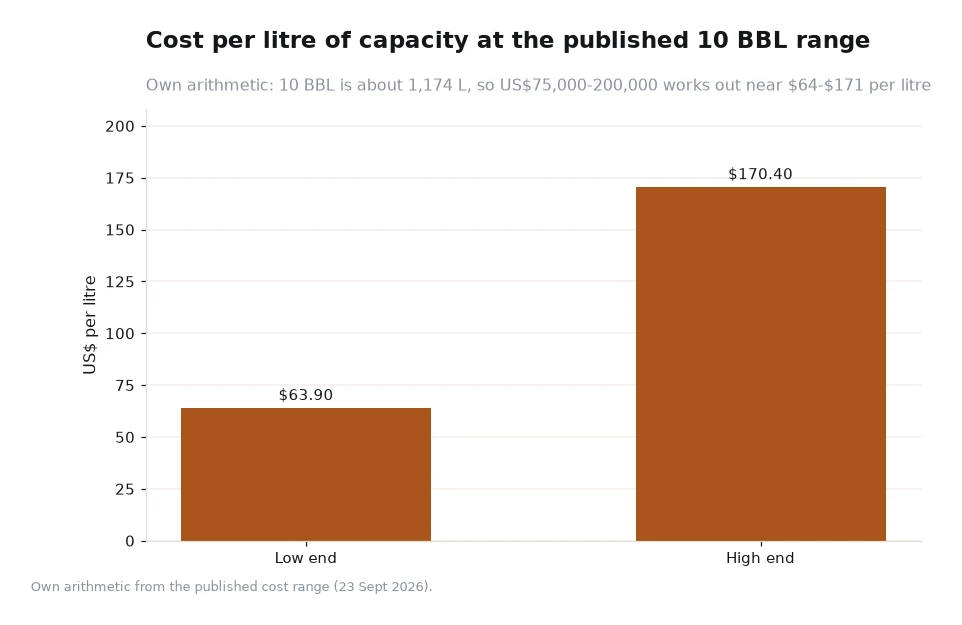
Take the published example of a complete 10 BBL system at around US$75,000–200,000, and the same source's conversion of 10 BBL to about 1,174 litres. At the low end, US$75,000 ÷ 1,174 L = US$63.9 per litre of installed capacity. At the high end, US$200,000 ÷ 1,174 L = US$170.4 per litre. Both figures are arithmetic on published numbers, not a quotation.
Now split that arithmetic against time as well. If the deposit is paid on day one and the tanks are brewing on day 90, the same 10 BBL system has been producing for 60 more days than an order that lands on day 150. At an example of 8 brews a month and 1,174 litres a brew, 60 days is about two months, roughly 16 brews and about 18,800 litres of capacity that the faster schedule makes available. The assumption list is explicit: 10 BBL per brew, no losses counted, eight brews per month. Change any of those and the number moves, which is exactly why the deposit date matters more than the delivery estimate given during the sales conversation.
Frequently asked questions
What is the published lead time from deposit to door delivery?
90–150 days, depending on the order. Small standard orders tend towards the lower end of the band, while large custom plants with more fabrication and more freight typically sit nearer the upper end.
Which stage delays an order most often?
Design changes after the drawing is released, because cut plate cannot be resized without rebuilding the vessel. Freight schedules are the second source of movement, and they are outside the factory's control.
Dates worth writing into the contract
Ask for the deposit date, the drawing approval date and the expected loading date, and treat the last one as the number the whole delivery window hangs on. Add the arrival port and the site access plan, including crane capacity and whether the largest vessel fits through the door upright.
A schedule built on those five dates survives a slow ship far better than a single promised delivery day. It also makes the 90–150 day range work for you rather than against you, because each stage has an owner and a piece of paper attached to it.
The lead time, inspection sequence and 10 BBL cost range quoted here come from the manufacturer's own website, read 23 Sept 2026; the per-litre and brew-calendar arithmetic is our own example with its assumptions stated in the text.[1] Confirm dates and figures against your own order documents.