Reviewing ceramic tile moisture absorption from quote to delivery means connecting a measured property to the exact product, production lot, and intended use. Put the test method and acceptance basis in the inquiry, confirm the report scope during supplier comparison, approve a traceable sample, and keep lot and packaging records through shipment. Absorption is one tile characteristic; the complete floor or wall system also depends on design, installation, site conditions, and other materials.
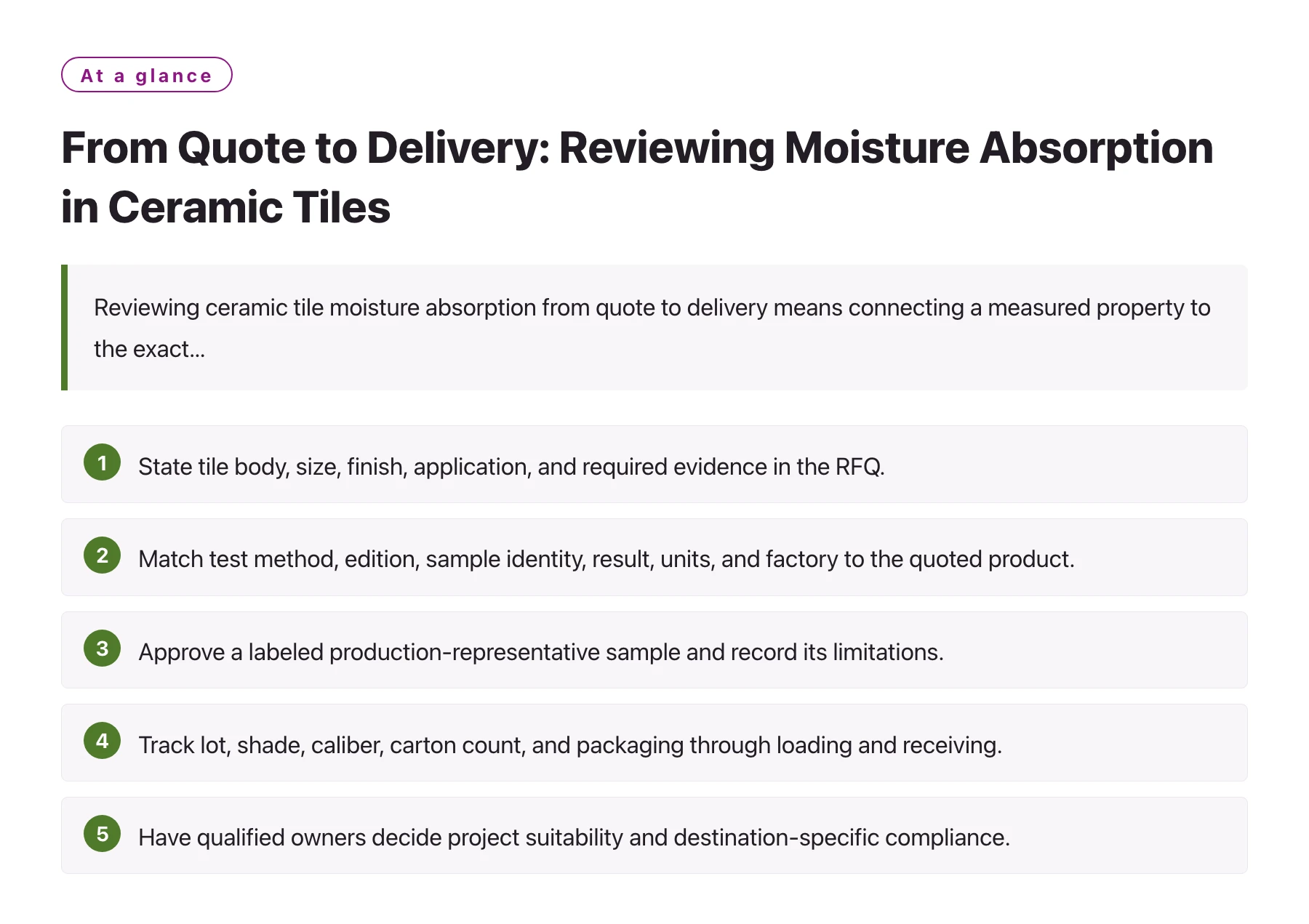
Key takeaways
- State tile body, size, finish, application, and required evidence in the RFQ.
- Match test method, edition, sample identity, result, units, and factory to the quoted product.
- Approve a labeled production-representative sample and record its limitations.
- Track lot, shade, caliber, carton count, and packaging through loading and receiving.
- Have qualified owners decide project suitability and destination-specific compliance.
Use four gates: comparable quotation, technical approval, production and packing control, and receiving reconciliation.
1. Put the product and application in the inquiry
Describe the tile body, manufacturing route if known, dimensions, thickness, surface finish, color, quantity, and intended use. Identify floor or wall application, interior or exterior exposure, wet-area conditions, traffic, cleaning, climate, destination, and project schedule. State which characteristics require evidence and which are preferences. Do not let the supplier infer a project’s acceptance limit from a broad phrase such as moisture resistant.
Name the technical standard and edition only when the project owner has selected them. ISO 10545-3:2018 specifies methods for determining water absorption and related density and porosity characteristics of ceramic tiles, with applicability to classification and product specifications. Confirm the contract’s required method and edition instead of assuming all reports use the same test. [1]
2. Compare quotations and report scope
Request suppliers to identify the exact model, plant, tile body, size, finish, and manufacturing lot associated with each report. Check result, units, test date, method, laboratory, sample source, and any stated limitations. If a report is for another size or product family, ask whether the issuer’s scope covers the offered variant. Keep a missing answer open rather than treating a nearby result as transferable.
Normalize commercial offers for size, finish, first-quality definition, carton quantity, palletization, packaging, testing, inspection, payment, delivery basis, and quote validity. Record each supplier’s proposed deviation. A similar absorption result cannot make two quotes equivalent if one supplier offers a different body, surface, or production site.
3. Decide what the absorption result means
Ask the designer or technical owner how the measured property relates to the intended application and applicable classification. Review it alongside any other required tile characteristics, such as strength, dimensions, surface, chemical resistance, frost-related performance, or slip-related criteria, only where project conditions call for them. Do not treat a single absorption figure as a complete product grade or installation approval.
A laboratory result applies to a tested specimen and stated method. Ask whether the sample represents regular production and what factory controls preserve consistency. If the report is old, names an unclear plant, or lacks product identifiers, request clarification or new evidence. For results near an acceptance limit, consult a qualified reviewer about method precision and the purchase agreement’s decision rule.
4. Approve and retain the reference sample
Request a sample from the named production source and label it with model, size, finish, factory, date, and lot if available. Compare dimensions, appearance, surface, edge quality, shade, and caliber using the project’s agreed conditions. Note what the sample can establish and what requires a test report, engineering review, or installation mock-up. Keep the sample protected and accessible to the buyer and supplier.
If approval is conditional, list each outstanding item and who owns it. Do not allow a visual approval to imply acceptance of absorption performance, market compliance, packaging, or future lot variation. Record signatories, revision, sample photographs, and any approved tolerance. A substitute sample needs its own change review so the reference does not drift unnoticed.
5. Control production and batch identity
Confirm that the purchase order carries the approved model, tile body, finish, dimensions, report reference, and lot-marking requirements. Ask how the factory identifies production lots and separates shades, calibers, and quality grades. Schedule checks when enough finished tiles are available and specify the sample method, tests, visual criteria, quantity tally, and response to a failure.
If the factory changes clay body, process, site, glaze, thickness, or supplier, ask whether the report and sample remain representative. Require written notice and a technical decision before the new version enters production. For a phased project, keep each batch linked to room or area quantities where continuity matters. Record any approved mix or lot separation so installers know which cartons belong together.
6. Pack for handling and route conditions
Set carton design, dividers, corner protection, pallet stack, wrapping, marks, and handling limits according to tile size, weight, route, and receiving equipment. Confirm carton labels show product code, dimensions, shade, caliber, lot, and quantity as agreed. Review pallet photos or a packed sample when packaging has not been used before. Avoid unapproved carton substitutions that remove traceability or protection.
Plan the container or consolidated shipment around package counts and weight. Reconcile carton, pallet, and piece quantities separately. Photograph representative marks, packaging condition, and loading stages where agreed. If the absorption report or certificate must accompany the shipment, identify the exact file and owner responsible for transmitting it to the importer or project team.
7. Verify documents and shipment disposition
Before release, match test reports, declarations, inspection findings, packing list, product schedule, factory, and lot references. Check that the actual cartons align with approved model, size, finish, shade, caliber, and quantity. Route market-specific compliance questions to the importer’s qualified owner. A supplier’s certificate should not replace a determination of whether the product and intended use fall under the relevant rules.
Set a hold process for damaged cartons, mixed lots, substituted tiles, missing reports, or unexplained quantity differences. Record who approves rework, replacement, credit, or a documented deviation. A loading date is not a technical approval. Retain the original issue, decision, and revised record together so the receiving team can see why the shipment proceeded.
8. Reconcile at receipt and close the file
On arrival, count by pallet and carton, inspect visible damage, verify labels, and compare the delivery with the packing list. Check that tile lots and shade or caliber information are usable for the planned installation. Record shortages, breakage, water exposure to packaging, or mismatched cartons before goods are distributed. Use a consistent evidence reference for photos, receiving notes, and claims.
Close the record when the delivered lot, report, approved sample, inspection result, shipment documents, and disposition agree. Buyers working with Shanghai JS Sourcing can maintain this chain across quotation, production, shipment, and receiving, while leaving final design and installation decisions to the project’s qualified professionals.
Sources
Frequently asked questions
What should a tile quotation include for absorption review?
Request exact product and factory identity, test method and edition, report result and units, sample scope, intended application, dimensions, finish, lot controls, packaging, quantity, and quote assumptions.
Does a test report for one tile prove every lot will match?
No. Link the report to its specimen and production scope, then review factory controls, batch identification, agreed checks, and change notices for the order and later replenishment.
Can absorption alone determine tile suitability?
No. Project use, other tile properties, local requirements, substrate, waterproofing, adhesive, grout, joints, and installation quality can all matter; ask the technical designer to define suitability criteria for the specific room and site conditions.
What should be checked when tiles arrive?
Reconcile carton and pallet counts, product code, size, finish, shade, caliber, lot, packaging condition, report references, and open shipment exceptions before distribution.