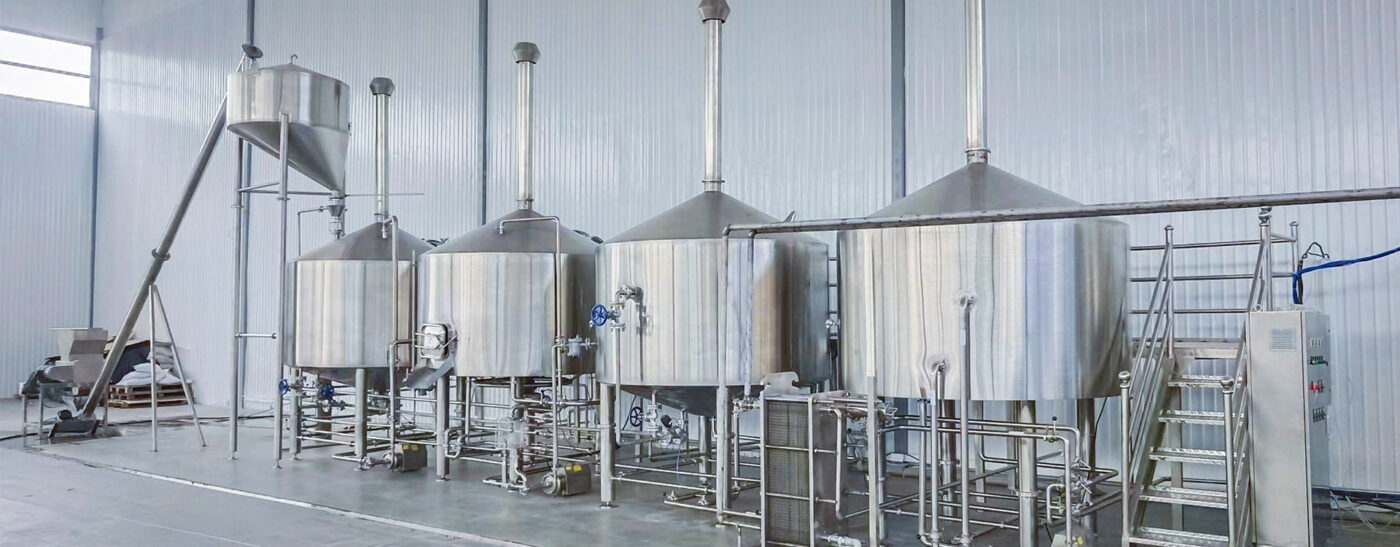
A turn-key brewery solution is useful for expansion because capacity depends on more than adding tanks or buying a larger brewhouse. The Brewers Association reports an industry water-use ratio around 7 barrels of water per barrel of beer, while efficient craft breweries can operate below 3:1. Its published benchmarking also measures energy per packaged barrel because utilities change materially as output grows. A turn-key project sizes brewing, fermentation, CIP, cooling, piping, controls, water, steam, and packaging around the same production target, reducing mismatches between equipment. For a brewery moving from 10,000 to 20,000 bbl/year, that system-level planning matters more than simply doubling vessel volume.
Brewery expansion starts with packaged beer volume, not vessel size. A plant targeting 20,000 bbl/year across 250 production days needs to average 80 bbl of packaged beer per production day. Production planning then has to work backward through packaging losses, cellar residence time, fermentation schedules, brewhouse cycles, cleaning periods, and maintenance. A 20% increase in cellar volume will not produce 20% more packaged beer if the brewhouse or packaging line is already operating near its available schedule.
That relationship explains why a turn-key project normally begins with a process map. Malt handling, milling, mashing, lautering, boiling, whirlpool, wort cooling, fermentation, maturation, bright beer storage, packaging, CIP, refrigeration, steam, compressed air, CO₂, water, drainage, and electrical systems are calculated as connected parts. The Brewers Association's 2017 benchmarking framework measured water and combined electricity and natural-gas consumption per barrel of packaged beer, rather than judging equipment in isolation.
| Expansion item | What should be checked before sizing |
|---|---|
| Brewing | Batches/day, cycle time, extract efficiency, wort volume |
| Cellar | Fermentation days, tank turns/year, beer mix |
| Cooling | Peak demand during wort cooling and crash cooling |
| CIP | Number of tanks, circuits, cleaning frequency |
| Packaging | Containers/hour, changeovers, operating hours |
| Utilities | Water, steam, electricity, compressed air, CO₂ |
Once production is mapped, the Brewhouse can be sized around an operating schedule instead of a nominal vessel volume. A 40 bbl system completing 3 turns can theoretically send about 120 bbl of wort to the cellar in one brewing day, before process losses are considered. If the brewery can only staff 2 turns, however, the practical schedule begins near 80 bbl. The extra vessel capacity has limited use unless labor, utilities, cellar space, and packaging can accept the additional wort.
Brewhouse sizing then leads naturally to cellar calculations because fermentation occupies equipment for days rather than hours. If a brewery produces 100 bbl of wort per brewing day and a beer occupies a fermenter for 14 days, the cellar needs enough working volume to accommodate overlapping batches plus cleaning and production scheduling. A portfolio containing a 21-day lager and a 10-day ale also cannot be modeled using one average residence time without allowing for the actual product mix.
A tank is unavailable not only while beer is fermenting. Filling, cooling, maturation, transfer, cleaning, inspection, and the next production slot all consume calendar time.
Cellar calculations also affect refrigeration. Wort may enter a fermenter near pitching temperature, but fermentation generates heat, while later crash cooling can require beer temperature to fall by many degrees within a defined period. Adding 6 fermenters therefore changes both total refrigeration use and peak demand. A chiller selected for the old cellar can become the limiting system even though every new tank has sufficient nominal capacity.
Cooling is only one utility affected by expansion. Brewing also consumes water for the product, vessel cleaning, rinsing, heat exchange, packaging, and utility operations. Brewers Association guidance reports an average brewery water-use ratio around 7:1 and notes that some craft breweries operate below 3:1; its cited BIER dataset included 211 observations and showed a 10% improvement over the reported period. At 20,000 bbl of annual beer production, the difference between 7:1 and 4:1 represents roughly 60,000 bbl of water before local operating conditions are considered.
Water use leads directly to wastewater planning because much of the incoming water eventually reaches the drainage system. High-strength brewery streams can come from beer losses, yeast, trub, product changeovers, cleaning chemicals, and vessel rinsing. The Brewers Association continues to treat water and wastewater as major brewery operating issues in its 2026 sustainability resources, with guidance covering water reduction, wastewater management, utilities, and facility expansion. A turn-key layout can therefore establish drainage routes, side-stream handling, CIP return, and wastewater interfaces before piping is installed.
CIP deserves the same capacity calculation as production equipment. A brewery expanding from 8 tanks to 16 tanks may roughly double the number of cellar cleaning events under a similar operating pattern, but the available cleaning window does not automatically double. Flow rate, chemical concentration, solution temperature, return condition, tank geometry, spray-device requirements, and circuit length all affect cleaning performance. Brewers Association educational material from the 2018 Craft Brewers Conference specifically addressed optimizing CIP for water savings, reflecting how closely cleaning and resource consumption are connected.
The CIP schedule then influences pipe and valve design. If two vessels require cleaning while another beer transfer is underway, routing has to keep the operations separated according to the brewery's hygienic design and operating requirements. A turn-key engineering team can define pipe diameters, valve arrangements, pump duties, instrumentation, slopes, drain points, and cleaning circuits before fabrication. That reduces field modifications after equipment arrives.
Automation becomes more relevant as the number of routes increases. A 2026 expansion may involve automated temperature control, pump sequencing, recipe steps, valve feedback, tank status, alarms, and CIP programs, but automation level should follow the operating model. A 10,000 bbl/year brewery running a limited product range may not need the same control architecture as a 100,000 bbl/year site handling frequent product changes and several simultaneous transfers.
More automation does not compensate for poor process sizing. Controls can sequence equipment, but they cannot create fermentation volume, refrigeration capacity, or packaging hours that were never installed.
Packaging therefore has to be included before the cellar is finalized. Assume the expanded cellar can release 100 bbl of beer per day. Since 1 US beer barrel equals 31 gallons, that represents 3,100 gallons before packaging losses. A packaging line's stated containers-per-hour rate should be adjusted for warm-up, changeovers, cleaning, planned stops, container supply, and normal operating interruptions. Even 15% less effective operating time can materially change the number of packaging hours required each week.
Packaging capacity also affects bright beer tank scheduling. If beer reaches the bright tank faster than the line can package it, the tank remains occupied and the next transfer waits. Increasing fermenter count alone can therefore move the capacity restriction downstream rather than remove it. Turn-key planning compares daily and weekly flow across brewing, fermentation, maturation, bright beer storage, and packaging before final equipment quantities are approved.
The same approach matters inside an existing building. A brewery opened in 2016 may be expanding in 2026 without gaining additional floor area. Tank diameter, ceiling clearance, column spacing, doorway dimensions, floor loading, drainage, pipe-rack space, maintenance access, and equipment removal routes can restrict the available layout. Vertical tanks may save floor area, but vessel height can affect installation access and building requirements.
Installation planning follows the physical layout. An operating brewery cannot necessarily stop production for several weeks while contractors connect every new system. Equipment positioning, utility extensions, piping, electrical installation, insulation, control-panel work, testing, and final tie-ins can be arranged around planned production stops. If a shutdown window is 48 hours rather than 7 days, more piping and electrical work may need to be prepared before the final connection.
Responsibility is another practical difference between turn-key and multi-supplier expansion. With separate suppliers, a tank manufacturer may stop responsibility at the vessel connection, while the piping contractor covers the line and an automation company handles sensors and controls. When a transfer fails during commissioning, several interfaces have to be checked. One integrated scope gives the brewery a clearer route for resolving mechanical, electrical, piping, and software issues during start-up.
That scope should still be written precisely. A quotation should state whether freight, unloading, rigging, insulation, field piping, electrical cabling, local utility connections, commissioning, operator training, spare parts, and documentation are included. A proposal that is 10% cheaper at the equipment stage can become more expensive after site labor and omitted services are added, so breweries should compare installed scope rather than stainless-steel purchase price alone.
Commissioning is where the engineering calculations meet actual production. Pumps should be checked against intended flow and pressure, instruments calibrated, valves tested, heating and cooling functions verified, CIP circuits tested, and automation sequences reviewed. Water trials can confirm routing before wort or beer enters the system. For an expansion involving 20 or 30 controlled valves, documenting valve state and interlocks before production is easier than diagnosing routing errors during a live batch.
Future expansion can also be allowed for without purchasing every future machine in 2026. Pipe headers can include planned connection points, control panels can reserve suitable I/O capacity, layouts can retain space for additional fermenters, and utility distribution can be designed with the next production stage in mind. Spending 100% of the future equipment budget today is unnecessary; providing practical connection points can reduce demolition and rework when another production increase is approved.
The financial comparison should therefore cover equipment, installation, utilities, production interruption, engineering, commissioning, and operating resource use. Brewers Association benchmarking has repeatedly tracked water and energy per packaged barrel because annual operating efficiency matters alongside equipment cost. A brewery producing 50,000 bbl/year experiences a much larger annual effect from a 1 bbl/bbl change in water use than a brewery producing 5,000 bbl/year.
For expansion projects involving a brewhouse, cellar, CIP, refrigeration, process piping, automation, and packaging interfaces at the same time, turn-key supply places the capacity calculations under one engineering scope. Production targets can be checked against tank residence time, utility demand, cleaning hours, packaging schedules, and building limits before fabrication begins. A brewery planning 20%, 50%, or 100% growth can then purchase equipment against a defined operating model rather than assuming that more vessel volume alone will produce the planned number of packaged barrels.